

 contact@tapestodigital.co.uk
 Too busy?
 Back
Back

 What customers say


.png?width=32&height=32&name=laser%20disc%20(1).png)


.png?width=32&height=32&name=Microcassette%20(1).png)


 Digital Services

.webp)
.png)

.png)

%20(70).png)
%20(67)-min.png)
%20(71).png)
%20(1126%20x%20658%20px)%20(480%20x%20448%20px)%20(6).webp)










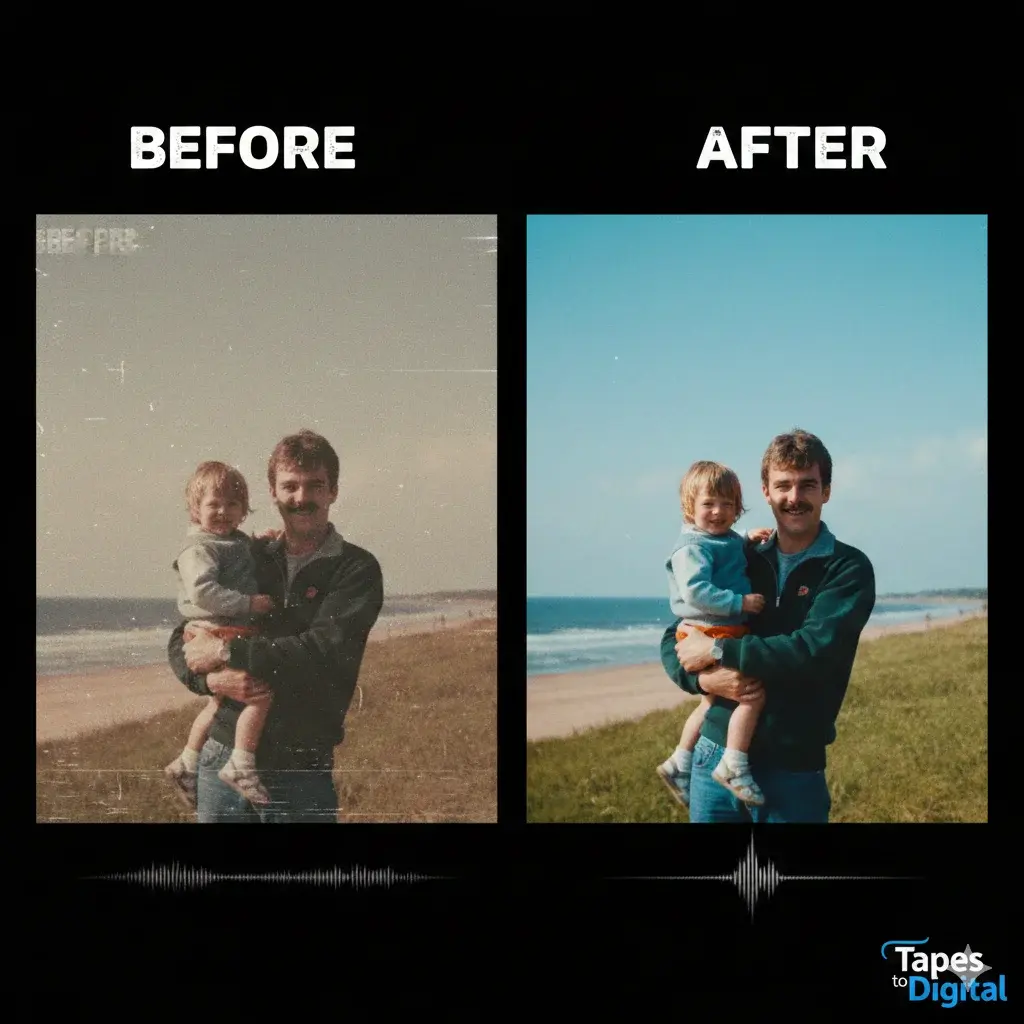
In the attic of many a UK household sits a cardboard box filled with plastic shells and magnetic ribbon. These are our weddings, our first steps, and our local heritage—trapped in formats like VHS, Hi8, and MiniDV. While they may look the same as they did in 1995, a silent process of degradation is occurring. The "before" is a fading memory; the "after" is a vibrant digital revival that brings the past into the present.
The Invisible Decay of Analogue Media
Every year that a VHS tape remains unplayed, it loses a fraction of its magnetic signal. In the UK, damp climates can accelerate this, leading to the dreaded "white mould" or sticky shed syndrome. When you finally find a working VCR to play these tapes, the "before" image is often heartbreaking: tracking lines dancing across the screen, colours that have bled into a muddy sepia, and a persistent hum that obscures the laughter of loved ones.
The first step in any VHS tape preservation is acknowledging that analogue is not permanent. Magnetic tape was never designed to last more than 20 to 30 years. As we move further into the 2020s, many of these tapes are reaching their "end of life" stage. Without professional intervention, the transformation from "ageing tape" to "lost data" becomes inevitable.
The Transformation: From Grainy VHS to Sharp Digital
The most striking "after" effect of professional digitisation is the immediate clarity. When you transfer VHS to digital, you aren't just recording a video; you are stabilising a crumbling signal.
Visual Clarity and Stability
In the "before" state, analogue video often suffers from "jitter" or "tearing" at the edges of the frame. This is caused by inconsistent timing in the tape's playback. Professional conversion uses Time Base Correctors (TBC) to synchronise the signal, resulting in an "after" image that is rock-steady. Gone are the days of fiddling with the tracking buttons on a dusty VCR; the digital file provides a clean, edge-to-edge picture.
Colour Rejuvenation
Analogue colours tend to shift toward the red or blue spectrum as the magnetic particles lose their alignment. Professional enhancing of digitised tapes involves meticulous colour correction. We balance the whites and restore the natural skin tones that have faded over decades, making your 1980s summer holiday look as bright as the day it was filmed.
Restoration Techniques: The Science Behind the Magic
The transformation isn't just about moving data from a tape to a USB; it’s about a technical "cleanup" that happens during and after the capture.
- Noise Reduction: Analogue video is inherently "noisy"—that grainy, snowy texture you see in dark scenes. Advanced software filters can identify this random noise and smooth it out without losing the essential details of the image.
- Sharpening and Upscaling: While we cannot "create" detail that isn't there, we can enhance the edges and contrast to make the footage look significantly better on modern 4K televisions.
- Frame Rate Optimisation: Older camcorder tapes often recorded at specific rates that can look "choppy" on modern monitors. The digital "after" version is optimised for smooth playback on everything from your iPhone to your smart TV.
If you are wondering about the best way to view these results, choosing the right digital format is essential. Whether it is an MP4 on a memory stick or a direct cloud upload, the goal is to make the "after" as accessible as possible.
Audio Revival: Clearing the Hiss and Pop
It isn't just the eyes that benefit from a media transformation; the ears do too. Anyone who has listened to an old cassette or the audio track of a VHS knows the familiar "hiss." This background noise is the sound of the magnetic tape moving across the playback head.
In the digital world, we can isolate these frequencies and significantly reduce them. Whether you are looking at converting vinyl to digital or rescuing an old dictaphone recording, the "after" is a crisp, clear soundscape where the voices of the past are no longer fighting against a wall of static.
Why Choose Tapes to Digital?
At Tapes to Digital, we treat every parcel that arrives at our UK studios—from Watford to Leeds—with the reverence it deserves. We understand that these aren't just "media assets"; they are your family's history.
- Professional Care Assured: We use broadcast-grade decks and high-end capture cards to ensure the "after" is the highest possible quality.
- UK-Wide Accessibility: With drop-off locations in London and beyond, getting your memories to us is simple and secure.
- Subject to Tape Condition: We provide honest assessments. If a tape is beyond repair, we will tell you, but we have successfully rescued footage that many thought was lost forever.
About Us
Tapes to Digital is the UK’s leading specialist in media preservation. Our mission is to bridge the gap between the analogue past and the digital future, ensuring no memory is left behind. Visit our About Us page to learn more about our process and commitment to quality.