

 contact@tapestodigital.co.uk
 Too busy?
 Back
Back
 What customers say


.png?width=32&height=32&name=laser%20disc%20(1).png)


.png?width=32&height=32&name=Microcassette%20(1).png)


 Digital Services

.webp)
.png)

.png)

%20(70).png)
%20(67)-min.png)
%20(71).png)
%20(1126%20x%20658%20px)%20(480%20x%20448%20px)%20(6).webp)







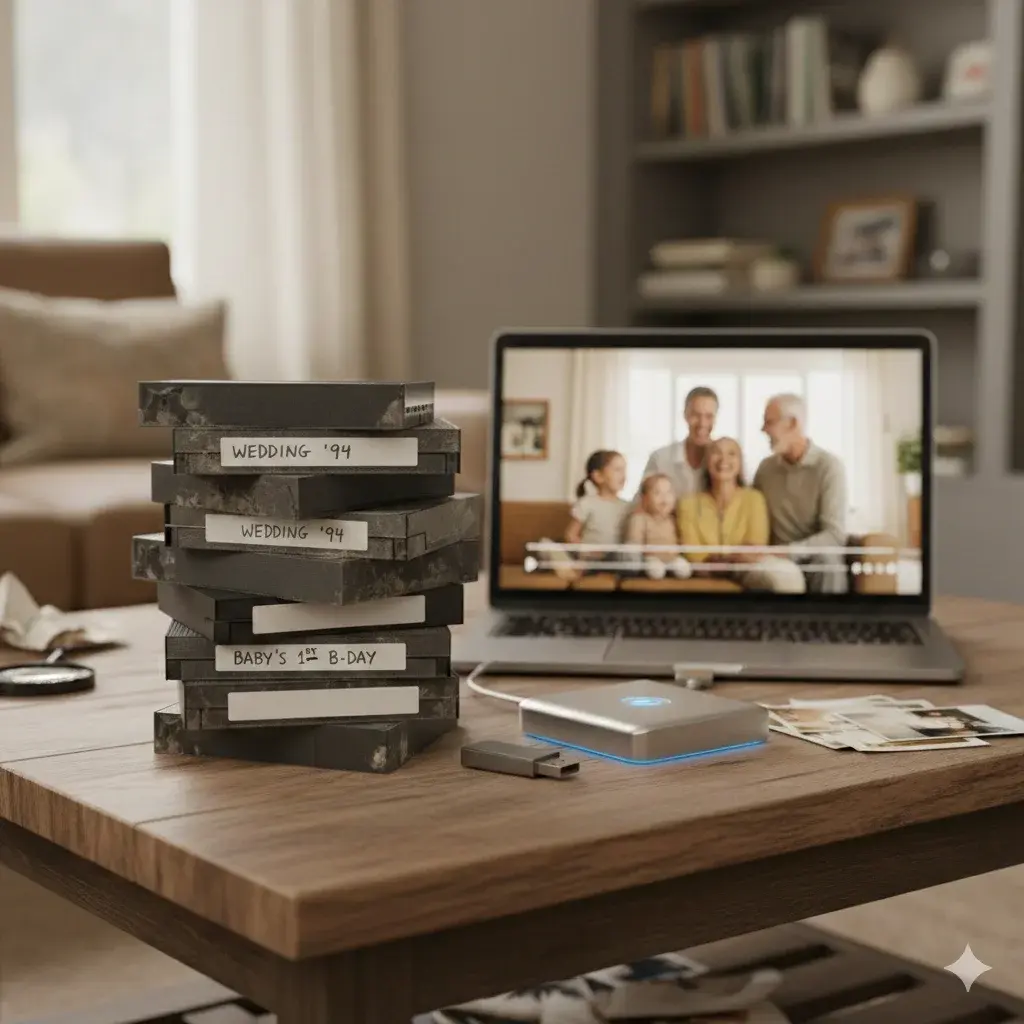
The muffled click of a plastic shell, the whir of a motorised spindle, and the flicker of tracking lines across a cathode-ray tube—these were the sensory precursors to watching our lives unfold on screen. For decades, the VHS tape and the camcorder cassette were the primary vessels for our history. They captured the shaky first steps of a toddler, the tearful "I do" at a summer wedding, and the boisterous laughter of a milestone birthday party. However, as we move further into the digital age, these physical archives are becoming increasingly fragile. Celebrating a milestone today isn’t just about looking back; it is about ensuring those memories are accessible for the future.
The Living Archive: Why Family Milestones Matter
Family history is more than just names and dates on a genealogical chart; it is a living archive of voices, movements, and personalities. When we watch a recording of a grandparent who has since passed away, we aren't just seeing a face; we are hearing the cadence of their speech and seeing the way they moved. These recordings provide a sensory connection to our roots that still photos simply cannot match.
Digitisation acts as a bridge between generations. By converting these older formats, you allow younger family members—who may have never seen a VCR—to engage with their heritage on the devices they use every day. Whether it is a graduation, a christening, or a simple Sunday roast, these "ordinary" moments become extraordinary when they are preserved against the ravages of time.
The Silent Threat: Why Magnetic Tape is Fading
Many families keep their tapes in lofts, garages, or at the back of wardrobes, assuming they are safe as long as they aren't being played. Unfortunately, magnetic tape is subject to a natural process of degradation known as "remanence loss" and "binder fly-off." Over time, the magnetic particles that hold the video data begin to lose their charge, and the glue holding them to the plastic backing becomes brittle.
In the UK’s damp climate, mould is another significant threat. Once mould takes hold inside a cassette, it can eat through the delicate layers of the tape. This is why VHS tape preservation tips are so critical before you even begin the conversion process. If you wait too long, the footage may become unplayable, turning your family milestones into silent, snowy static.
The Emotional Impact of Rediscovering Lost Moments
There is a unique kind of magic in seeing footage you haven't viewed in twenty or thirty years. Often, we find "hidden gems" on tapes we thought were blank or unimportant. You might find a snippet of a long-forgotten holiday or a candid moment behind the scenes of a major celebration.
When you unlock lost footage, you are effectively reclaiming a piece of your identity. It allows families to gather around a modern screen and share stories, fostering a sense of belonging and continuity. In a fast-paced world, these digital archives provide a grounding point, reminding us of the milestones that shaped our journey.
Technical Precision: Enhancing the Aesthetic of Old Footage
One of the most significant advantages of professional digitisation is the ability to improve the viewing experience. While we have a certain nostalgia for the "VHS look," modern technology allows us to clean up much of the visual noise that plagued early home recordings.
Professional services can employ colour correction and noise reduction to bring back the vibrancy of a wedding dress or the clarity of a child's voice during a school play. This isn't about erasing the past, but rather transforming home video aesthetics so that the focus remains on the people and the event, rather than the technical limitations of the 1990s.
Choosing the Right Format for Your Family Legacy
When deciding how to store your newly digitised memories, it is important to consider both accessibility and longevity. While many people initially think of DVDs, the trend has shifted heavily toward cloud storage and USB sticks.
- MP4 Files: These are the gold standard for flexibility. They can be played on smart TVs, tablets, and phones, and are easily shared via social media or email.
- USB Sticks: Ideal for physical backup and easy transport. For many, transferring VHS to a memory stick is the most convenient way to keep a family library in one place.
- DVDs: Still a popular choice for those who prefer a physical disc to put on a shelf, often serving as a great gift for older relatives. Our VHS to DVD service adds a disc for £6 on top of the per-tape price, with the MP4 files included.
Deciding which digital format is best depends on how your family intends to interact with the footage. Most experts recommend a "3-2-1" backup strategy: three copies, on two different media types, with one stored off-site (like in the cloud).
The Professional Difference: Safety Over DIY
While DIY conversion kits are available, they often come with significant risks. Cheap USB capture cards can produce "jittery" video and out-of-sync audio. More importantly, old playback equipment that hasn't been serviced can "eat" your irreplaceable tapes.
A professional service ensures that the playback deck is clean and the tension is correctly adjusted. This level of [professional care assured] means your tapes are handled by experts who understand the fragility of the medium. Given that these are one-of-a-kind records of your family milestones, the risk of a DIY mishap is often too high a price to pay.
Preserving Culture and Genealogy Through Video
Digitisation isn't just a personal endeavour; it’s a contribution to social history. Home videos often capture local dialects, fashion trends, and landscapes that have since changed. For those interested in genealogy, video footage provides a "living" element to a family tree that documents can't provide.
In some cases, camcorder footage has even been used for linguistic research or preserving cultural festivals. Your family’s celebration of a local UK tradition in the 1980s might be a valuable record of how that community once lived.
Why Now is the Time for Digital Transformation
The window for high-quality conversion is slowly closing. Every year that passes increases the risk of chemical breakdown within the tapes. By taking action now, you ensure that your family's milestones remain a vibrant part of your present, rather than a decaying relic of the past.
At Tapes to Digital, we specialise in treating your family history with the respect it deserves. From our London location to our studios in Leeds and Watford, we are dedicated to helping UK families safeguard their legacies.
[About Us] | [Why Choose Us]
FAQ Section
Q: How long does it take to digitise a collection of family tapes? A: Turnaround times vary depending on the size of the order and the state of the media. Professional care is assured for every tape to ensure the highest quality transfer.
Q: Can you convert tapes that have visible mould on them? A: Yes, in many cases, tapes can be cleaned and repaired before the digitisation process begins. This is subject to tape condition.
Q: Is MP4 better than DVD for family videos? A: MP4 is generally considered more future-proof and easier to share across modern devices, while DVDs are excellent for physical archiving.
Q: Do I get my original tapes back after they are digitised? A: Absolutely. Your original tapes are returned to you along with your new digital files.
Q: What happens if a tape is blank? A: We only charge for tapes that contain footage. If a tape is found to be blank during the process, we will inform you accordingly.