

 contact@tapestodigital.co.uk
 Too busy?
 Back
Back

 What customers say


.png?width=32&height=32&name=laser%20disc%20(1).png)


.png?width=32&height=32&name=Microcassette%20(1).png)


 Digital Services

.webp)
.png)

.png)

%20(70).png)
%20(67)-min.png)
%20(71).png)
%20(1126%20x%20658%20px)%20(480%20x%20448%20px)%20(6).webp)










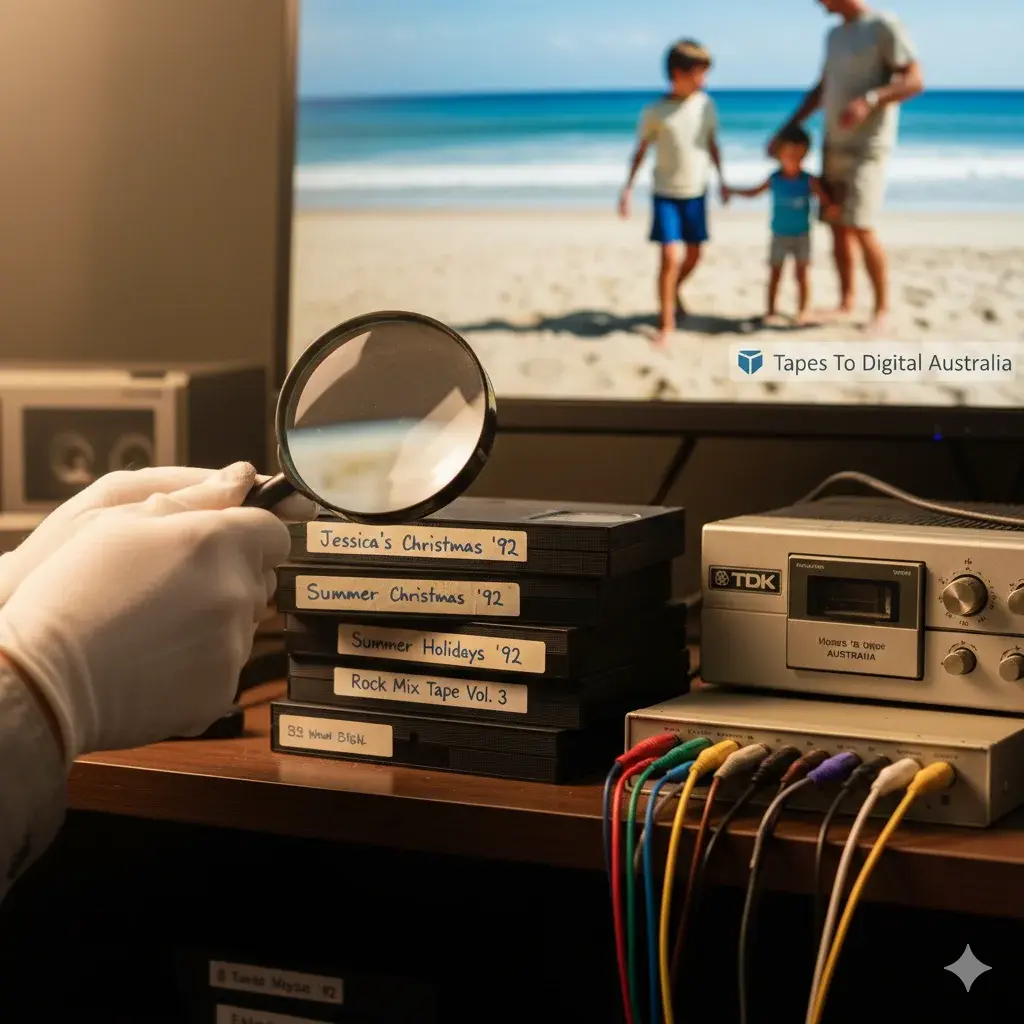
Preserving a moment in time requires more than just a quick scan; it demands an understanding of the fragile nature of magnetic media. Whether it is a dusty VHS in the back of a cupboard or a precious audio cassette in the lounge room, these recordings are aging and degrading daily. For families across the suburbs of Australia, the mechanical whirr of a VCR is a distant memory, but the content on those tapes remains irreplaceable.
The Race Against Time: Why Quality Matters Now
The life expectancy of magnetic media is limited, and many Australian recordings from the 1980s and 90s are now pushing the envelope of viability. Environmental factors common to our climate—such as fluctuating temperatures and unstable humidity—actively threaten to degrade the remaining magnetic particles.
When a tape begins to fail, you may notice clicks, pops, and significant video noise. To rescue these memories, they must be converted into accessible, long-lasting digital formats before the physical carrier becomes unplayable. Understanding your roadmap to why you should convert video tape to digital is the first step in stopping this degradation.
Physical Inspection and Professional Care
The first step toward high-quality digitisation is a thorough physical inspection. At Tapes To Digital, each tape is physically inspected to identify issues like dirt, dust, or damage.
Handling Mould and Damage
In soggy or humid regions, it is common to encounter mould or fungus on old tapes. Fungus feeds on the binder of the tape and can cause irreversible damage if played in a standard machine. Professional intervention is required here; experts use specialised processes to stabilise and clean the media before attempting a transfer. For those interested in preventative measures, reading our guide on VHS tape preservation tips can help you protect your collection before it reaches our lab.
NTSC vs PAL Handling
It is vital to identify the recording format of your cassettes. While most Australian home videos were recorded in the PAL format, media from the US or Japan often uses NTSC. NTSC requires additional processing and specialised playback equipment to ensure the frame rate and colour information are captured accurately.
Technical Standards for Superior Digitisation
To achieve the best possible quality, the capture process must use professional-grade components
-
Real-Time Capture: High-quality digitisation is never a "high-speed" process. Each tape must be digitally captured in real time to ensure every frame is preserved without glitches
- Output Formats: For the best balance of quality and compatibility, MP4 is the standard delivery format. However, for those seeking archival-level fidelity, we can provide uncompressed MOV or AVI files upon request.
- Resolution: While standard VHS has limited resolution, using a professional VHS to Digital service allows for the use of specialised equipment to stabilise the image
The Role of Specialised Equipment
Many DIY methods involve cheap USB dongles that "bake in" poor quality and compression artifacts. In contrast, professional labs use well-maintained broadcast equipment designed to yield the best possible images from aging media.
For those with 8mm camcorder tapes, using the original source is always better than a later dub. If your footage was shot on Video8 or Hi8, ensuring you convert 8mm to digital correctly ensures that the original resolution is fully realised in the digital domain.
Why Choose Us
Tapes To Digital Australia professionally converts old video tapes, films, and audio into modern formats while prioritising the safety of your memories.
- Professionalism: We use well-maintained, specialised equipment and avoid over-promising results that depend on the original condition of the media
- Security: Your content is kept private and confidential, used only for the purpose of conversion and delivery.
- Australian Presence: We serve the entire country, including major hubs like our expert video to digital services in Sydney. Whether you are sending your tapes via a secure Australia Post satchel or visiting a local drop-off point, your media is handled with care
About Us
Tapes To Digital is a dedicated media preservation business. Our purpose is to rescue, preserve, and modernise fragile or obsolete media, making memories safe, shareable, and future-proof. We operate with clarity and empathy, knowing many of these items are irreplaceable family treasures. For interstate customers, we provide clear estimates and professional handling for every mail-in order.