

 contact@tapestodigital.co.uk
 Too busy?
 Back
Back

 What customers say


.png?width=32&height=32&name=laser%20disc%20(1).png)


.png?width=32&height=32&name=Microcassette%20(1).png)


 Digital Services

.webp)
.png)

.png)

%20(70).png)
%20(67)-min.png)
%20(71).png)
%20(1126%20x%20658%20px)%20(480%20x%20448%20px)%20(6).webp)








How to Prepare Your Tapes Before Sending Them for Digitisation
If you’ve decided it’s time to digitise your old tapes, you’re already doing the most important thing: protecting your memories for the future.
For many families, though, the next step feels uncertain.
Should you clean the tapes?
Do they need rewinding?
What if they’re mouldy or damaged?
The good news is that most tapes need very little preparation at all. This guide walks you through what is helpful, what to avoid, and how to send your tapes with confidence.
Why Preparing Your Tapes Matters
Preparing your tapes properly helps to:
-
Reduce the risk of damage during transit
-
Avoid unnecessary delays
-
Make sure nothing gets overlooked or misidentified
It also gives you peace of mind, knowing you’ve done what you can before handing them over to a professional digitisation service like Tapes To Digital.
Don’t Worry – Most Tapes Need Very Little Preparation
This is worth saying clearly:
you do not need specialist equipment, cleaning products, or technical knowledge.
Old tapes are delicate, and well-meaning DIY attempts can sometimes cause more harm than good. Many people consider handling everything themselves at first, but understanding the difference between DIY conversion versus professional digitisation can help you avoid unnecessary risks.
Step 1: Gather All Your Tapes in One Place
Start by collecting everything you’d like digitised, such as:
-
VHS and VHS-C
-
Video8, Hi8, and Digital8
-
MiniDV
-
Betamax and other legacy formats
It’s common to find tapes stored across cupboards, drawers, or lofts. Bringing them together helps ensure nothing meaningful is forgotten.
If you’re unsure what format a tape is, that’s completely fine. We identify formats as part of the process. You may also find it useful to read our guide on basic VHS tape preservation tips while gathering your media.
Step 2: Check Labels (But Don’t Rewind Everything)
If your tapes are already labelled, leave them as they are. Notes like “Christmas 1997” or “First holiday” can be extremely helpful.
A few simple guidelines:
-
Don’t relabel unless necessary
-
Don’t worry if labels are missing or unclear
-
There’s no need to rewind tapes — this is checked during inspection
If you want to add notes, it’s best to do so on a separate piece of paper rather than on the cassette itself.
Step 3: Leave Cleaning to the Professionals
This is one of the most important points.
Please don’t attempt to clean tapes yourself, particularly if:
-
You notice white residue or mould
-
The tape looks dusty or warped
-
The cassette hasn’t been played in many years
Cleaning tapes safely requires specialist equipment and controlled conditions. If a tape needs attention, we’ll assess it carefully and explain what’s possible. Our article on VHS tape preservation before digitising goes into more detail about what helps and what to avoid.
Step 4: Sort by Format if You Can (Optional)
If you’re comfortable doing so, grouping tapes by format can help:
-
VHS together
-
Smaller camcorder tapes together
This step is entirely optional. If you’d rather not sort them, that’s absolutely fine. Every item is checked individually once it arrives.
Step 5: Pack Your Tapes Securely for Sending
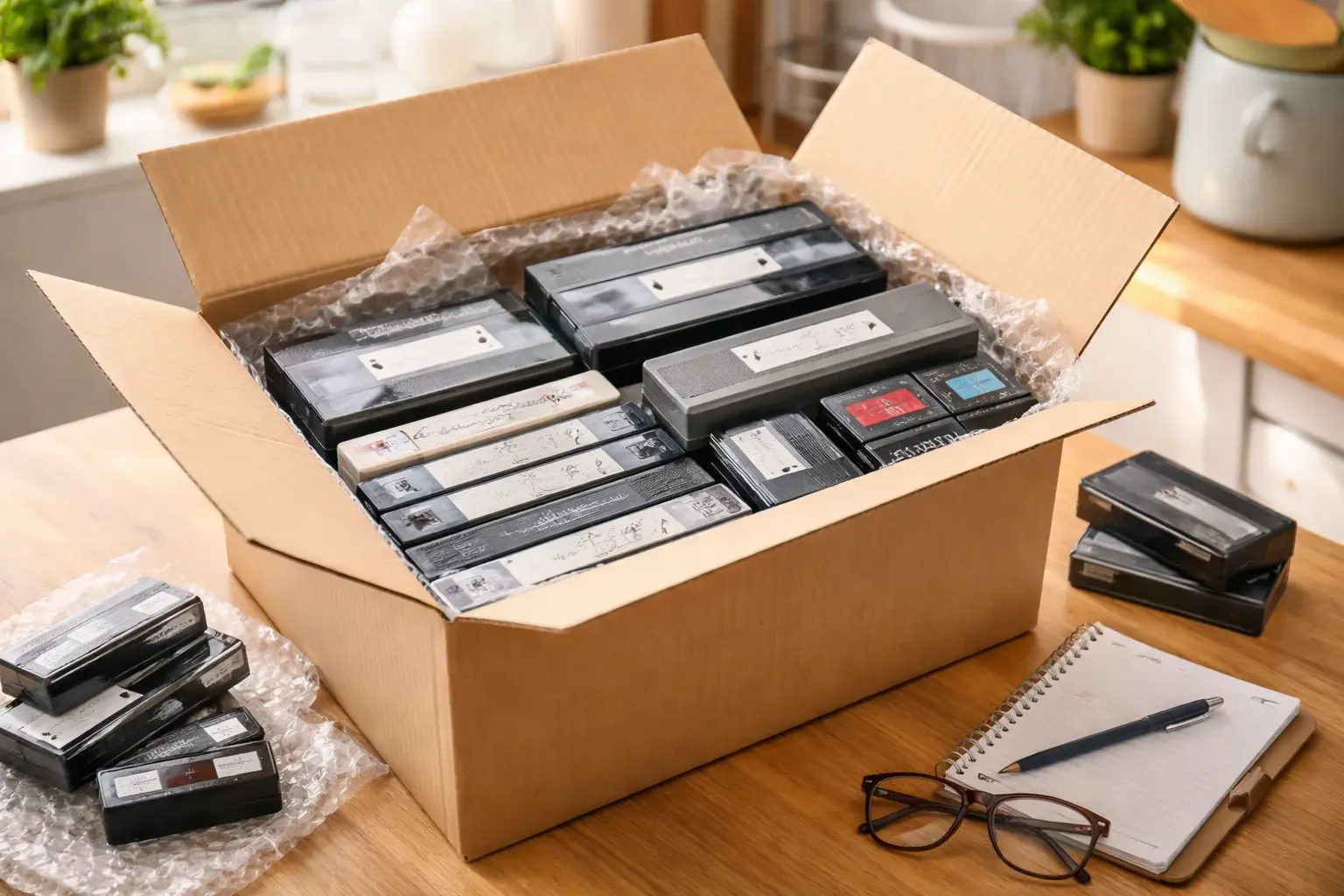
Careful packing helps protect your tapes during transit.
We recommend:
-
Keeping tapes in their original cases where possible
-
Wrapping bundles in bubble wrap
-
Using a sturdy cardboard box (rather than a padded envelope)
-
Filling any empty space so items don’t move around
Avoid storing or packing tapes near strong magnets or heat sources.
If you’re local, you may prefer a drop-off option. You can find details on our London digitisation service or your nearest location page.
Common Worries We Hear (and Why They’re Usually Fine)
“Some tapes haven’t been played in 30 years.”
That’s very common. Age alone doesn’t mean a tape can’t be digitised.
“I’m not sure what’s on them.”
Many customers aren’t. Rediscovering forgotten moments is often part of the experience.
“What if something can’t be converted?”
We’re always honest. If a tape has issues, we’ll explain clearly and never guess.
If you’re still deciding who to trust, our guide to choosing a professional VHS digitisation service explains what to look for. You can also learn more about our approach on our Why Choose Us page.
What Happens Once Your Tapes Arrive
When your tapes arrive with us:
-
Each item is logged and inspected
-
Format and condition are checked
-
Any special handling requirements are identified
-
Digitisation is carried out in real time
-
Files are delivered in your chosen format
If you’re unsure which delivery option is right for you, our guide to choosing the right digital format for VHS conversion explains the differences clearly.
Your media is treated as private and irreplaceable. You can read more about our values and process on our About Us page.