

 contact@tapestodigital.co.uk
 Too busy?
 Back
Back

 What customers say


.png?width=32&height=32&name=laser%20disc%20(1).png)


.png?width=32&height=32&name=Microcassette%20(1).png)


 Digital Services

.webp)
.png)

.png)

%20(70).png)
%20(67)-min.png)
%20(71).png)
%20(1126%20x%20658%20px)%20(480%20x%20448%20px)%20(6).webp)










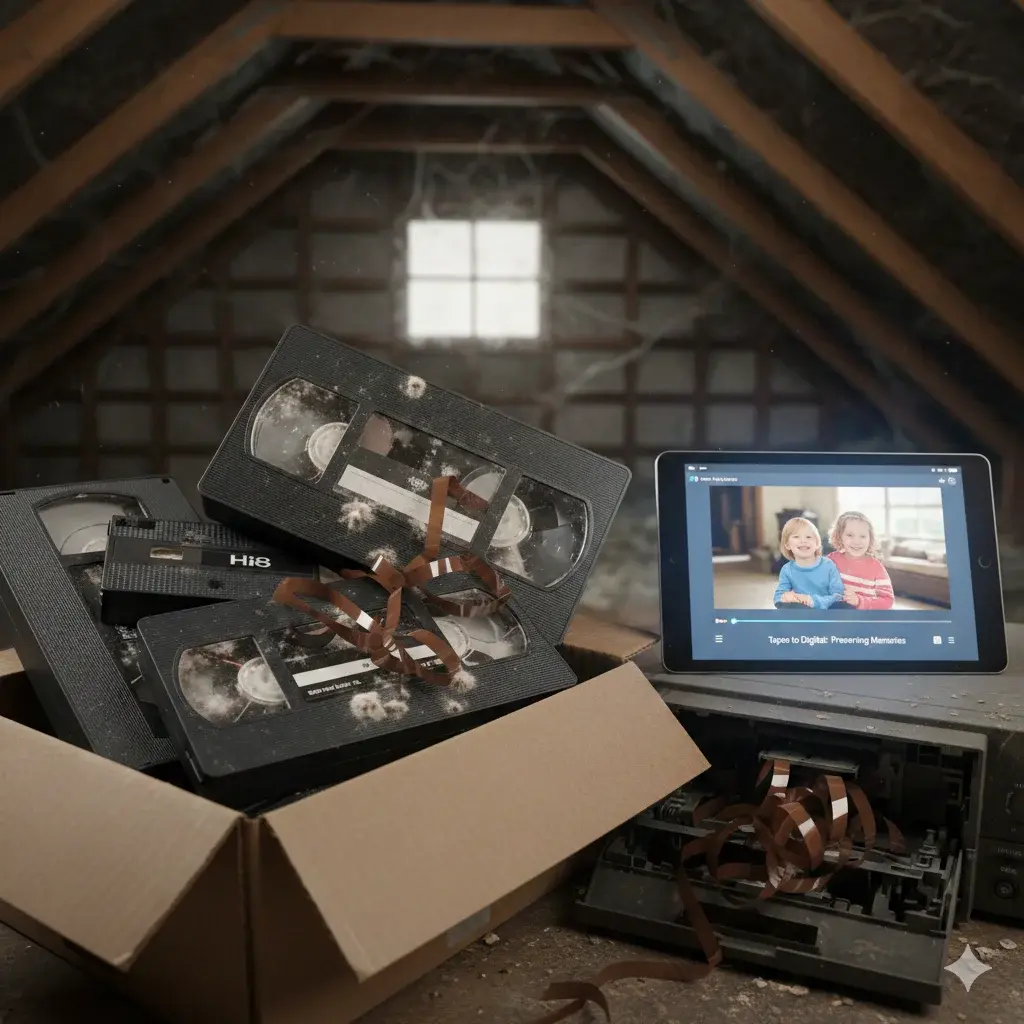
For many households across the UK, the loft or the cupboard under the stairs holds a treasure trove of history. From the grainy footage of a first Christmas to the sun-bleached memories of a summer holiday in Blackpool, camcorder tapes like VHS, VHS-C, and Hi8 captured a generation’s most precious moments. However, these physical objects were never designed to last forever. As we move further into the digital age, the clock is ticking for magnetic media. Understanding the internal mechanics of a tape is the first step in realising why audio tape digitisation and video conversion are no longer just options, but necessities.
The Invisible Decay: What Happens Inside Your Tapes
A video tape is a sophisticated feat of 20th-century engineering, consisting of a long strip of plastic coated with magnetic particles held together by a binder. Over time, this binder begins to fail. In the industry, this is often referred to as "Sticky Shed Syndrome." The binder absorbs moisture from the UK’s notoriously damp air, causing the layers of the tape to stick together. When you attempt to play a tape in this condition, the magnetic coating can literally peel off the plastic backing, leaving you with a transparent strip of nothingness and a ruined playback head.
The "magnetic hum" and the "plastic click" of a cassette being inserted into a camcorder are sounds of the past, but the physical reality of those tapes is very much a present-day concern. If you notice a white, powdery substance through the clear window of your cassette, this is likely a fungal growth. Mould thrives on the organic binders used in tape manufacturing. Without VHS tape preservation tips before digitising, these biological hitchhikers will consume the very data that holds your memories.
The Science of Magnetic Tape Degradation
To understand the risk, one must look at the chemistry. Magnetic tapes rely on remanence—the ability of the magnetic particles to stay in a specific orientation. However, these particles are subject to "magnetic orientation loss" over decades. External magnetic fields, and even the earth's own magnetic field, slowly scramble the alignment of the particles. This results in "snow" on the screen, colour bleeding, and a general loss of sharpness.
Furthermore, the plastic base of the tape (usually polyester) can become brittle. As the plasticisers leach out, the tape loses its flexibility. A brittle tape is prone to snapping or stretching during the high-tension environment of a VCR's rewind cycle. This is why transferring VHS to digital is a race against time. The longer the tape sits, the more its physical structure compromises the signal it holds.
Environmental Villains: Humidity and Heat
In the UK, many people store their old camcorder tapes in garages or attics. These are the worst possible environments for magnetic media. Fluctuating temperatures cause the tape to expand and contract. This mechanical stress can lead to "tracking" issues, where the video head cannot stay aligned with the recorded path. High humidity, as mentioned, leads to mould and binder hydrolysis.
If you are looking to convert 8mm to digital, it is vital to check the storage conditions first. Even a seemingly "mint condition" box can hide tapes that have undergone significant chemical shifts. Professional services often have to perform "tape baking"—a delicate process of controlled heating—to temporarily stabilise the binder enough to get a single, high-quality transfer.
Mechanical Risks: Why Old Players are Dangerous
It isn't just the tape that is at risk; the hardware required to play them is disappearing and decaying. Rubber belts inside old VCRs and camcorders turn into a sticky goo or snap over time. Old capacitors can leak, and tension arms can fall out of alignment. If you put a rare family tape into a faulty player, the machine may "eat" the tape, crinkling the delicate ribbon beyond repair.
This is a primary reason why many are moving toward VHS to DVD conversion or, more commonly, digital file formats. Modern devices no longer support analogue inputs, and finding a working, high-head-count VCR in a local UK shop is becoming nearly impossible. If you would like a disc as well as the files, our VHS to DVD service adds £6 per disc, with the MP4 files included.
The Risks of DIY Digitisation
While there are cheap USB "capture cards" available online, the danger of DIY options for digitising VHS tapes is significant. These budget devices often lack the Time Base Correction (TBC) hardware needed to stabilise a shaky analogue signal. Without TBC, your converted video may suffer from "jitter," dropped frames, or audio-sync issues that make the footage unwatchable.
Professional services use industrial-grade decks and high-end converters to ensure that every possible bit of data is captured from the decaying magnetic strip. They can also offer enhancing digitised tapes through colour correction and noise reduction, breathing new life into footage that has faded over the last thirty years.
Choosing a Professional Digitisation Service
When looking for a video conversion service, trust and quality should be your top priorities. You are handing over irreplaceable family history. A reputable service will provide a clear process, from the moment your parcel arrives to the final delivery of your digital files. Whether you are in Watford or Leeds, professional care is essential for ensuring your memories transition safely to the digital world.
Why Choose Us?
At Tapes to Digital, we treat every cassette as if it were our own. Our process is designed to handle delicate, aged media with the utmost respect. We don't just "copy" tapes; we preserve history using professional-grade equipment that outclasses any home-conversion kit.
About Us
We are a dedicated team of specialists focused on high-quality digitisation across the UK. From VHS and MiniDV to vinyl and audio cassettes, our mission is to ensure that no memory is left behind in an obsolete format.
FAQ
Q: Can a tape with mould be saved? A: Often, yes. However, it requires professional cleaning. Attempting to play a mouldy tape in a standard VCR will spread spores to the machine and likely destroy the tape.
Q: How long does a VHS tape actually last? A: Under perfect conditions, they can last 20–30 years. However, most tapes in UK homes are already reaching the end of their functional lifespan due to environmental factors.
Q: What is the best format for my converted videos? A: MP4 is currently the most versatile format. It is easy to share, back up to the cloud, and play on modern smart TVs. You can read more about choosing the right digital format here.
Q: Is it safer to keep my tapes or digitise them? A: Digitising is significantly safer. Once a digital file is created, it does not degrade over time and can be copied infinitely without quality loss.
Q: Can you convert very small camcorder tapes? A: Yes, formats like VHS-C and Hi8 are frequently converted. These smaller tapes are often at higher risk because the tape ribbon is thinner and more fragile than standard VHS.